Digital Sovereignty for us is choosing the right tools and platforms from partners that we can trust and work with.
We started using:
LibreOffice from The Document Foundation
Business Email with Strato
Email Client from Thunderbird
Browser from Firefox
Operating System from Ubuntu Pro
Cloud storage with Strato
Notetaking from Joplin
GenAI chatbot from Mistral
Video hosting with MakerTube
Search with Mojeek
Code hosting with Codeberg
so that we practice Digital Sovereignty before we preach it.
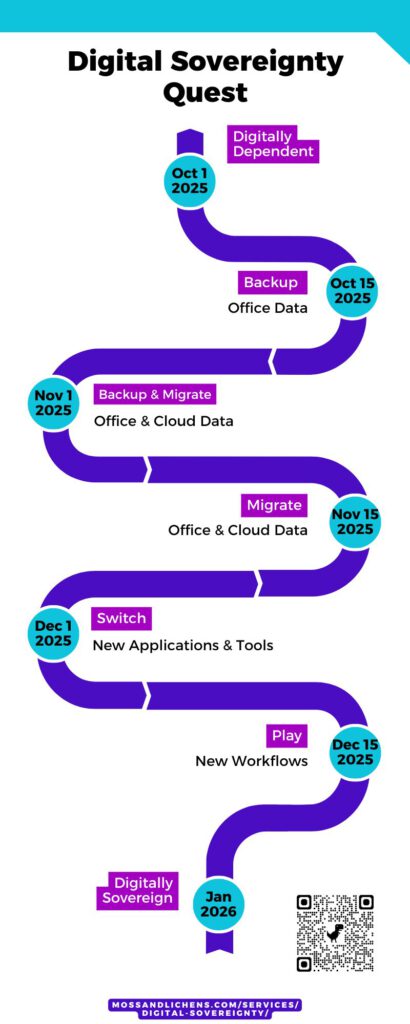
We have migrated from Microsoft 365(Office, Outlook, Edge, OneNote, OneDrive and Teams) and Windows 11 so, we understand the pain and gain when one takes the move to Digital Sovereignty.
We can help clients (freelancers, small and medium size businesses) make that move with confidence step by step understanding the IT planning and Financial budgeting required
Moss and Lichens uses

Strato Business Email and HiDrive
Strato Business Email is a German-hosted email service that prioritizes data protection and compliance with EU regulations. It offers features like custom domains, spam filters, and encrypted storage, making it a trusted choice for businesses seeking sovereignty over their communication tools.
Strato HiDrive is a German-hosted cloud storage service that prioritizes data protection and compliance with EU regulations. It offers features like end-to-end encryption, GDPR alignment, and German data centers, making it a trusted choice for businesses and individuals seeking sovereignty over their data.

Jitsi Videoconferencing
Jitsi is a free, open-source video conferencing platform that works directly in web browsers without requiring downloads. It enables secure voice and video calls, chat, and screen sharing across desktop and mobile devices.
Jitsi advances digital sovereignty by letting you self-host the entire conferencing stack on your own servers.
LibreOffice
LibreOffice is a free, open-source office suite that includes tools for word processing, spreadsheets, and presentations. It supports open document formats, ensuring long-term data accessibility and independence from proprietary software. Many German public institutions and businesses use it to comply with digital sovereignty requirements.
Ubuntu Pro
Ubuntu Pro is a Linux-based operating system offering long-term support, security updates, and compatibility with enterprise software. It reduces dependency on proprietary OS vendors, supports open standards, and is widely used in German government and educational institutions.
Thunderbird
Thunderbird is a free, open-source email client developed by Mozilla, offering features like calendar integration (via add-ons) and strong privacy controls. Unlike Outlook, it doesn’t rely on cloud-based services, making it ideal for users prioritizing data control and security.
Firefox
Firefox is an open-source browser focused on user privacy, with features like enhanced tracking protection and regular transparency reports. It is developed by the non-profit Mozilla Foundation, reducing reliance on commercial tech giants and aligning with Germany’s push for digital autonomy.
Joplin
Joplin is an open-source note-taking app that prioritizes privacy and user control. It offers end-to-end encryption, cross-platform support, and local storage options, making it a trusted choice for individuals seeking sovereignty over their notes and ideas. You can also sync it with Strato HiDrive via WebDAV for seamless, secure access to your notes across devices.

rustdesk
RustDesk is a free, open-source remote desktop application (RustDesk). It lets you connect to and control distant machines across Windows, macOS, Linux, and Android.
RustDesk advances digital sovereignty by letting you self-host the connection infrastructure on your own hardware.

Le Chat from Mistral
Le Chat by Mistral AI is a compelling choice for Digital Sovereignty due to its European origins, ensuring GDPR compliance and reducing reliance on non-EU providers. Its open-source nature and self-hosting capabilities allow users to maintain control over their data, aligning with sovereignty goals and avoiding vendor lock-in. It also offers vibe coding for AI-powered, context-aware code assistance, canvas mode for structured content creation, and image generation/editing for visual tasks.

PeerTube
PeerTube is a free, open-source, decentralized video platform developed by the French non-profit Framasoft, first released in 2018. It’s often described as a federated alternative to YouTube — but instead of one company running one giant platform, anyone can host their own video instance (server) using PeerTube’s software.
Code hosting from Codeberg
Codeberg is a German-based, non-profit code hosting platform that prioritizes privacy and open-source collaboration. It offers unique features like Git repositories, issue tracking, and CI/CD pipelines without tracking or ads.
It is good for Digital Sovereignty because it keeps code and data under European jurisdiction, with over 500,000 users and a commitment to 100% open-source, ad-free, and tracking-free operations.
ERP and CRM from odoo
Odoo is a free, open-source business management software suite (ERP) developed by the Belgian company Odoo S.A., first released in 2005 (originally as TinyERP, then OpenERP). It’s one of the world’s most widely deployed open-source ERP systems, used by millions of companies from small businesses to large enterprises.

READY for a chat?